

Issue #36
On Criticism

Criticism thrives in creative spaces. In architecture school, design work is developed through weekly critiques aka desk crits, charrettes, and reviews. All ideas and efforts are subject to critical dissection. Reviewers often excise the fat from plump new concepts, biopsy unsuspecting blemishes that slip through, and graft precedents onto new projects. We pretend the criticism isn’t personal the way an amputation isn’t personal, but it is. Creatives are affected by the feedback, but wounds scab over.
As a musician who has pitched music to curators and labels, recorded and released over a dozen songs, and performed for thousands of people, criticism truly sucks the joy out of making music. Over years of mostly negative criticism, you become a rigid fortress where nothing gets to you anymore, not even the good stuff. Is this what artists deserve? Does all the criticism amount to anything?
There is certainly a time and a place for criticism. If I’m in a workshop, professional, or educational setting, I welcome feedback. Ideas shift from mine to ours. Over time, creative work becomes less precious and more playful. Feedback lets others into the process, allowing for community and collective improvement.
Other times, criticism hits you at the wrong time. After releasing my solo record, Hex Sign, I solicited feedback from music curators. The record was complete—mixed, mastered, and released. I had no more money to market or rework the project, so requesting critiques from strangers wasn’t the right move. I didn’t have an audience, so I was just hoping to potentially find one. The feedback I received was pretty hard to hear at this stage. Here are a few critiques I received for some of the songs on my record.





Thankfully, I had already self released my record before I heard these comments. Negative criticism can steer you far off course if heeded at the wrong time.
I avoided going to architecture school for several years before the pandemic forced my hand. Years before, I had worked for the Boston Society of Architects and heard some nagging problems from coworkers, ARE test takers, and licensed architects about the state of the profession. The low wages, long hours, and barriers to entry all left a bad taste in my mouth. The more I knew, the less I wanted to be an architect. I was paralyzed by critiques of the profession. The pandemic and its resulting financial instability drove me toward graduate school with the ultimate goal of job security.
I never knew any architects growing up, but I was inspired by my father who’d studied architectural drafting as a young man but couldn’t afford to finish college. My dad was a self-employed handyman and my mom worked at a grocery store. All this to say, I was entering my professional journey with limited resources and guidance.
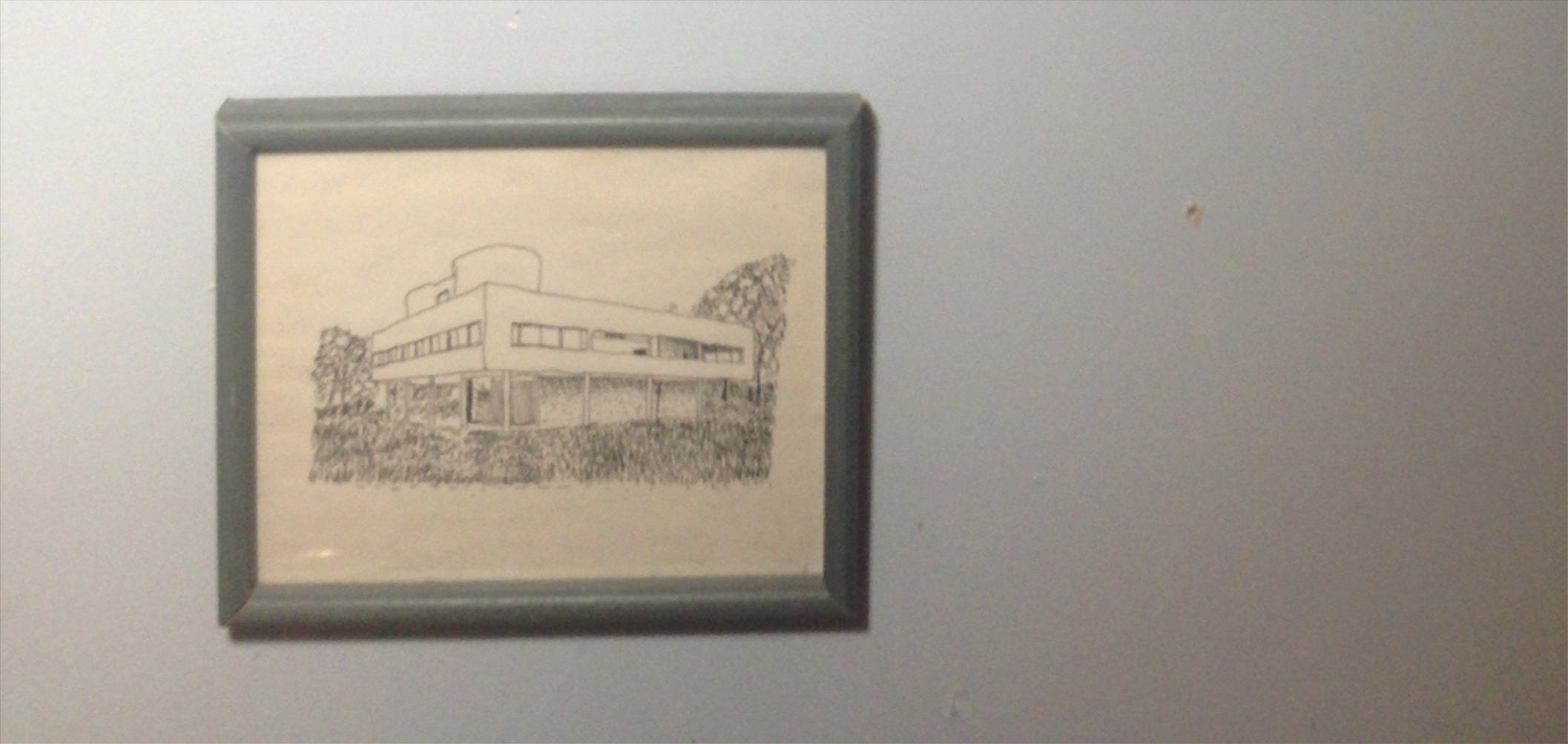
At twenty-two, I remember taking my first architectural survey course on twentieth-century architecture. Without even knowing what it was, I brought my dad’s old sketch of Le Corbusier’s Villa Savoye with me to Boston. One week I was delighted to finally learn what it was, the next I was reading misfits’ architecture blog posts “The Dark Side of the Villa Savoye” and “The DARKER Side of Villa Savoye” outside of class. They were as ominous as they sound, and I was immediately disillusioned by architectural criticism. The latter blog post left me with this, “I’m sure that, if we cared to look, we would find that other supposed architectural masterpieces would have a similar amount of shitty things, if not more.” I doubled down—writing my final paper as a critique of Villa Savoye.
Another early architectural criticism blog I followed was McMansion Hell. When Kate Wagner first started it in 2016, I was nauseated by the trend taking shape in my hometown of Nashville, TN. I too loved to hate ugly houses. This is also when I started to lament the exclusionary nature of architecture which narrowly catered to the wealthy, and even the wealthy didn’t have access to good design. Is this a problem a blog post can fix?
Perhaps the Office for Political Innovation’s “Superpowers of Ten” can provide an alternative solution. The performance looks beyond the “frames of exclusion” presented in Charles & Ray Eames’s film “Powers of Ten”. From space debris to suburban grass culture, the performance analyzes the messy centers and margins embedded in the film, zooming in and out in its own way. The performance supplements the otherwise “frictionless and apolitical” film with narratives and context. This performance deconstructs the flawed concept of neat narrative-based sequences. Reality is often incidental and muddy, full of incongruities and contradictions. While I’m sure the performance required many hours of dedicated research, it also offers an approachable, inviting perspective. Unlike the ominous and destructive critiques in “The Dark Side of the Villa Savoye” and “The DARKER Side of Villa Savoye,” “Superpowers of Ten” felt constructive.
Good critics are out there. One of my favorite music blogs is Post-Trash, a site that focuses on positive music reviews, premieres, and interviews. Post-Trash was founded and edited by Dan Goldin from 2015-2024, and they premiered my record, Hex Sign, in 2022. Here’s a snippet from Dan’s review:
There’s a rawness to Barte’s performances and some ambiguity to her lyrics, singing with both earnest introspective and abstract feeling. With minimal arrangements that often end a ways away from where they began, there’s clarity within the skeletal performances, using distorted hums, sparse piano, and looped melodies, to build a steady framework. Barte’s vocals do most of the heavy lifting, and she’s more than capable to do so, with a commanding voice that never needs to take a commanding tone to grip your attention.
It’s not a glowing review by any means, but it builds on what I created rather than chipping away at it. Post-Trash is constructive music criticism. How refreshing! I’ve seen music curators on Substack fall into the “good critic” category. The new music landscape looks healthier and better cared for with more and more “good” critics chiming in.
So what is the point of criticism? Is it to improve the genre, art form, or artist? Who gets to decide what projects carry more weight than others?
Architecture and music exist in the realm of taste. Where creatives live and die by the whims of the public. Not all criticism is unwarranted or bad, but anyone can decide to become a critic. Criticism comes very easy to most of us, and we are exposed to it everyday. Critiquing the world around us is healthy. We should want our favorite artists’ work to be better, sharper, more vivid. We should ask more from our politicians and cities. So, I feel a bit lost on this issue. It’s complicated.
Before pursuing graduate school, I was only receiving negative architectural perspectives: they were at work, school, and online. I couldn’t see myself fitting into the profession. I still have trouble seeing myself fitting into the profession, but that’s an even better reason to stay. When you are only catering to the few, you are blind to things outside their circle of interest, and you end up with McMansion Hell or worse.
i have been collecting various thoughts on this topic for ages with the intent of posting. i hope you don't mind me quoting you when I eventually do? but a lot of it is about how I think most music criticism shouldn't really be aimed at the artist but at the listener.
Feedback, for me, is what I might ask for before a song is completed, while I have time to change it. Once it’s out there… I’m much less interested in criticism because music is so *subjective*. When I read the criticisms of your song that you posted, what’s missing are the words “I think”, or “For me” ahead of the comments. A good constructive critic should appreciate the distinction between subjective and objective comments!