

Issue #45
Cellars

Cellars in New York City are some of the most honest places on earth. They never expect you to come, nor do they care. You see them as they are. Cellars are where electric, gas, and water services run along the underbelly of the first floor. All according to their own organizational logic—connecting to their corresponding sources, meters, then splintering off to the floors above.


Cellars are where to find vertical, six-inch-diameter pipes or soil stacks serving as conveyors for sewage which feed into the city’s sewage system. In many ways, cellars show us how physically connected each building is to the city’s networks and systems.
These spaces reveal how the floors above are supported both structurally and systematically. A cellar allows us to assess, maintain, and modify these systems too. City inspectors frequent cellars to monitor boilers to ensure ongoing operational safety. A building’s superintendent might use a cellar to store building materials or replacement parts that support building maintenance.
I once surveyed a restaurant in the West Village. Among containing building services, their cellar supported restaurant operations. They used their cellar for food and wine storage, an office tucked away under the stairs, and restrooms. All supportive elements layered here in a busy yet coordinated dance. Electrical conduit ran above insulated hot water pipes. Food storage racks doubled as employee backpack storage. Fridges and wine racks lined up like soldiers along the narrow and shallow passageway. Trash and recycling collected just outside in the subterranean alleyway, steps below the sidewalk.
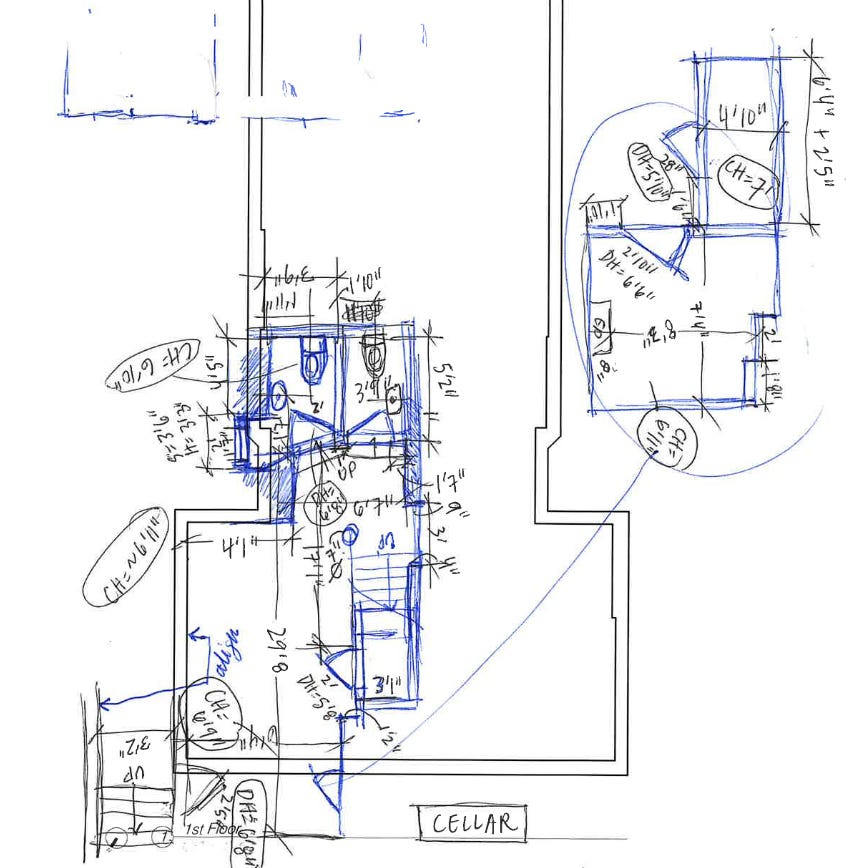
Despite the chaotic arrangement of elements, everything could be accessed easily and efficiently. Busy restaurants require it. Any delay or interruption to restaurant service increases overhead costs and risks negative reviews.
Cellars often tell a different story than their first floor counterparts. I once measured a picture frame shop on the Upper East Side. The first floor featured floor-to-ceiling frame samples covering every surface of the shop and a counter for customer transactions. The cellar contained the workshop, an employee bathroom, and thousands of framing materials stacked like hay. The display logic of the public facing level gave way to the operational logic of the cellar.


Multi-family residential cellars are the domain of the building’s superintendent who often keeps cellar rooms locked as a way to safeguard from tampering and subsequent service interruption. Sometimes supers are cagey about divulging what’s behind certain locked doors. I had a survey job that needed me to determine where a new electrical service could run to support the installation of a new AC unit. And to do that I needed to see extra rooms in the cellar that connect the electric meters to the conduit channels that run up to serve each apartment. This super didn’t want to let me see anything. Cellars are often messy and hard to make sense of with little information. Unknown unknowns make my job much harder. But cellars are a super’s jurisdiction, and I’m just some unwanted guest being nosey.
Cellars and their keepers make their own rules and don’t conform to the organizational norms that drive our world. After all, these spaces are private and rarely witnessed by the public. The people that frequent cellars get to shape them in peculiar ways that prioritize access and utility. These priorities make cellars exceedingly honest. Seeing a cellar is like popping open the hood to a car or seeing an MRI of an abdomen. Ceiling heights are often too low to frame and drywall around the layered service lines. What you see is what you get.
I still get surprised when I visit a new cellar. I recently found wood formwork impressions in a 1906 concrete slab, while I was surveying an apartment building which triggered this reflection.
I’m attempting to write a song in the spirit of this newsletter. Cellars are honest, private, unconditioned, unapologetic, and layered. For this exercise, I decided to layer different timescales: a week, a day, a sunset, and six weeks. To represent privacy, I left the subject relatively ambiguous while using descriptive language like, “I’m bumping my head on the cabinet,” to ground the song. Unconditioned is represented through guitar dynamics which range from a delicate, plucked waltz to heavy distortion.
I wrote this song after hitting my head so hard it warranted a trip to the local urgent care. I’m fine, but the injury made me stop and sit with some things I’d been moving past. I got to reflect on my grandmother’s passing in May and unfurling family drama.
One Week

It’s just one week since the bad news
I’m lifting my arms up they’re heavy
I’m bumping my head on the cabinet
It’s just one day since the soreness
It’s just one week since the sun set

If you could take it back
You wouldn’t skip a beat
You’re lifting up your arms
You don’t feel a thing

The air is clear
The sun is setting
In Clyde, OH

I’m no big better
But I’d bet that you’d
Hold up the tradition

It’s just six weeks since the bad news
I’m lifting up my arms they’re heavy
I’m bumping my head on the cabinet
It’s just one day since the soreness
It’s just six weeks since the sun set
I’ve yet to add melody to join the guitar part with the lyrics, but that is my task this week. These lyrics came together in about 5 minutes. The guitar part took more like 20 minutes since I’m trying out different techniques (faster tempo and 3/4 time). Please excuse the metronome!