

Issue #16
Big Roof Spans

This month I am taking a songwriting workshop taught by Brian Eno. Each week we are given a new assignment that explores the concepts Brian presents in the live online lecture. The second assignment asked us to write a song in an uneven time signature and use a randomized permutation of D and G chords.
We could choose the time signature, so I went with 3/4 to keep it simple. After flipping a coin 8 times, I landed on this chord progression: G D G G G G D G. Then, I jumped straight into Logic, a digital audio workstation (DAW), to begin the writing exercise.
I typically don’t work this way, and this process jolted me out of my usual writing routine. I think Brian did this intentionally—creating a limited environment that could allow us to write from our edge. The limited (and somewhat unpredictable) chord progression and uneven time signature, prompted me to focus on writing a strong melody that could cut through the chaos. Melodies are also one of my favorite things to write, so I enjoyed this part of the assignment.
We were given some lyrical phrases to start with, but I quickly left them to write my own (some rules are meant to be broken). The lyrics were inspired by a site visit I had at work the week prior. For some added context, the site visit occurred after the demolition phase had started, and we could now see the existing structure which was in poor condition. We could see bowing joists, cracked structural elements, and water damage among other problems.
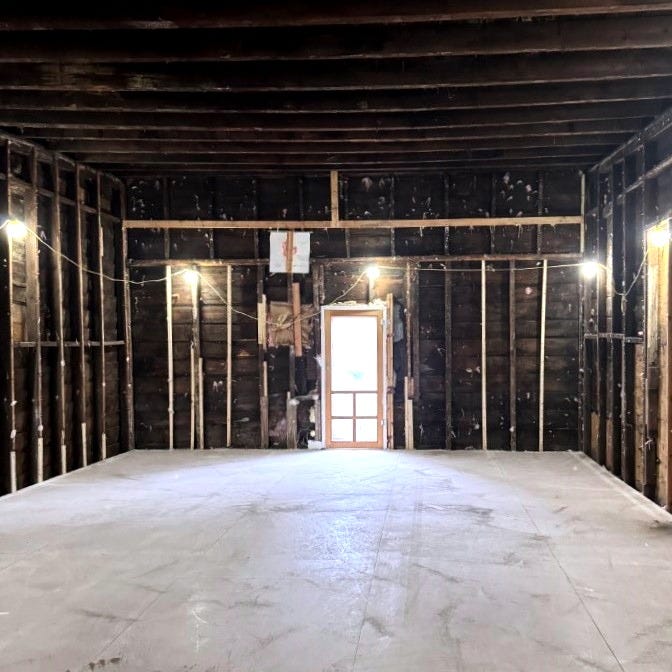
Our structural engineer was with us and even he was concerned. We kept wondering, “was this addition ever filed? Who built this?” The unevenly spaced wall studs, bowing roof joists, piecemeal sheathing, and water damage suggested this was a DIY endeavor. We were baring witness to the unfortunate reality that skylights were decidedly off the table, and that we were not making any money on this project.
Without further ado, here is my attempt at the assignment:
Nothing Was Filed

When did you come to that thought?
My hands are dry, my mind gets caught
We’re not making money on this project
We went on site, we saw the damage

The roof was bowing, the span too great
Nothing was filed, the studs aren’t straight
Nothing was filed, the studs aren’t straight
This is far from my typical songwriting style, but I am pleased with the result. After all, I took this class to get out of my comfort zone and explore new writing techniques. This song emerged from several unique conditions: an uneven time signature, an irregular chord progression, and an uneasy topic. Without the rocky terrain, I might not have created the prominent, layered vocal parts. Without the waltz rhythm, I might not have created such a sing-song-y melody.
The irregular chord progression mirrors the lyrical content too. Notice how the pattern (G D G G G G D G) almost looks like a large roof span. With the four internal Gs spanning the mirrored GD/DG bookends. I will illustrate the idea below.
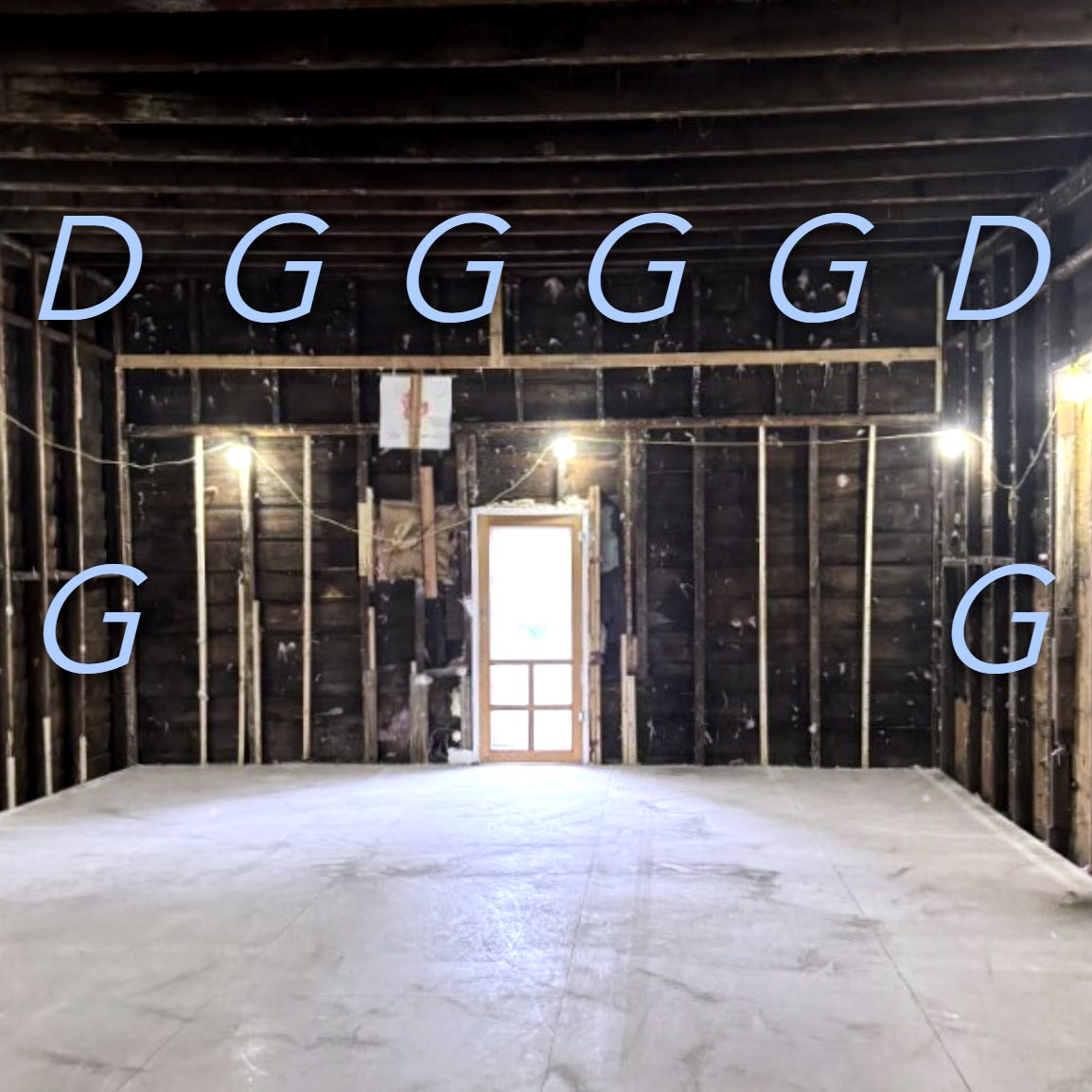
See how lyrical content mimics the the chord progression? This is why I love songwriting. You can layer meaning to nearly every aspect of the process. For a progression as arbitrary as G D G G G G D G, the lyrical content transforms a random progression into an intentional one. Even when the progression emerged before the lyrics, I was able to make sense of the random chord progression in light of the lyrics.
Each songwriting element helps you see the song differently. Without the lyrics, the song doesn’t quite make sense. It is too random and formless to really grasp. As I mentioned in Issue #13, each element may not be able to stand alone. Through the layering of rhythm, lyrics, and chords, a song becomes a substantive space you can start to understand.
Through the constraints Brian Eno presented, I could create a wildly different song than I am used to creating. Yet, the song remains true to my style. The assignment added resistance to my otherwise undirected writing process, and I was able to write and record a demo of “Nothing Was Filed” in about 1.5 hours.
Constraints made this assignment achievable in a short amount of time. Many of the constraints simplified the decision making process. I didn’t have to choose the chords or the progression. I had to maintain a 3/4 meter which prompted the melodic rhythm. The simplicity of the chords tempered with their irregularity inspired me to create meandering, layered vocals. The decision making process was quick—I didn’t ponder all of my options. Once I found something that worked, I went with it. This assignment was an exercise in creative restraint. What can I do with a limited scope? What can I create in two hours? Sometimes constraints can be freeing.
Giveaway
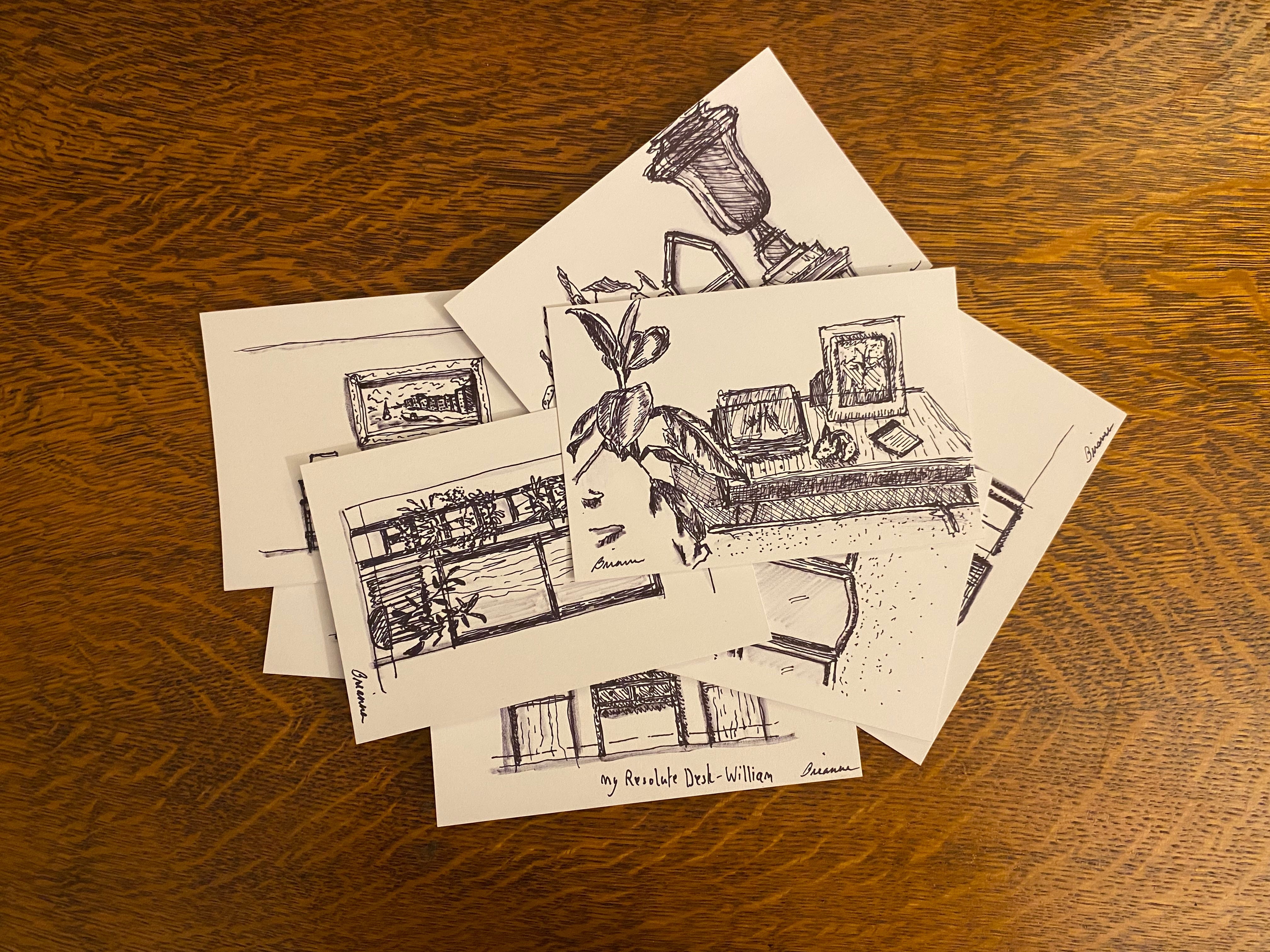
We made it to 200 subscribers here at Building Songs, so I am doing a giveaway! Thanks for supporting me—I couldn’t possibly do it without you. I feel like celebrating, so I am going to giveaway an original Building Songs sketch drawn by yours truly.
To enter—like this post, comment “200,” and subscribe by Friday, Jan 31st at 11:59 EST!
I will tag the winner in the comment section of this issue.
That was a really interesting post about using constraints as a way to free up creativity. Very cool that you're taking a workshop with Brian Eno and it looks really interesting.
I hope you share something on his idea of surrender (something I have found to be very important in creative writing, but I'm curious how he sees it or brings it about).
The song is beautiful